> ## Documentation Index
> Fetch the complete documentation index at: https://docs.galileo.ai/llms.txt
> Use this file to discover all available pages before exploring further.
# Distributed Tracing with OpenTelemetry
> Stitch traces across two agents in different processes using OTel and the GalileoSpanProcessor.
When two agents run in separate processes and call each other over HTTP, OpenTelemetry's W3C `traceparent` header carries the trace context across the wire. Galileo joins all spans that share a trace ID into a single trace.
If both services are Python and use the Galileo SDK directly, [Distributed Tracing (Beta)](/sdk-api/logging/distributed-tracing) is simpler. Use the OTel approach when your services use different agent frameworks (Microsoft Agent Framework, Google ADK, LangChain, etc.) or different languages.
## What you'll see in Galileo
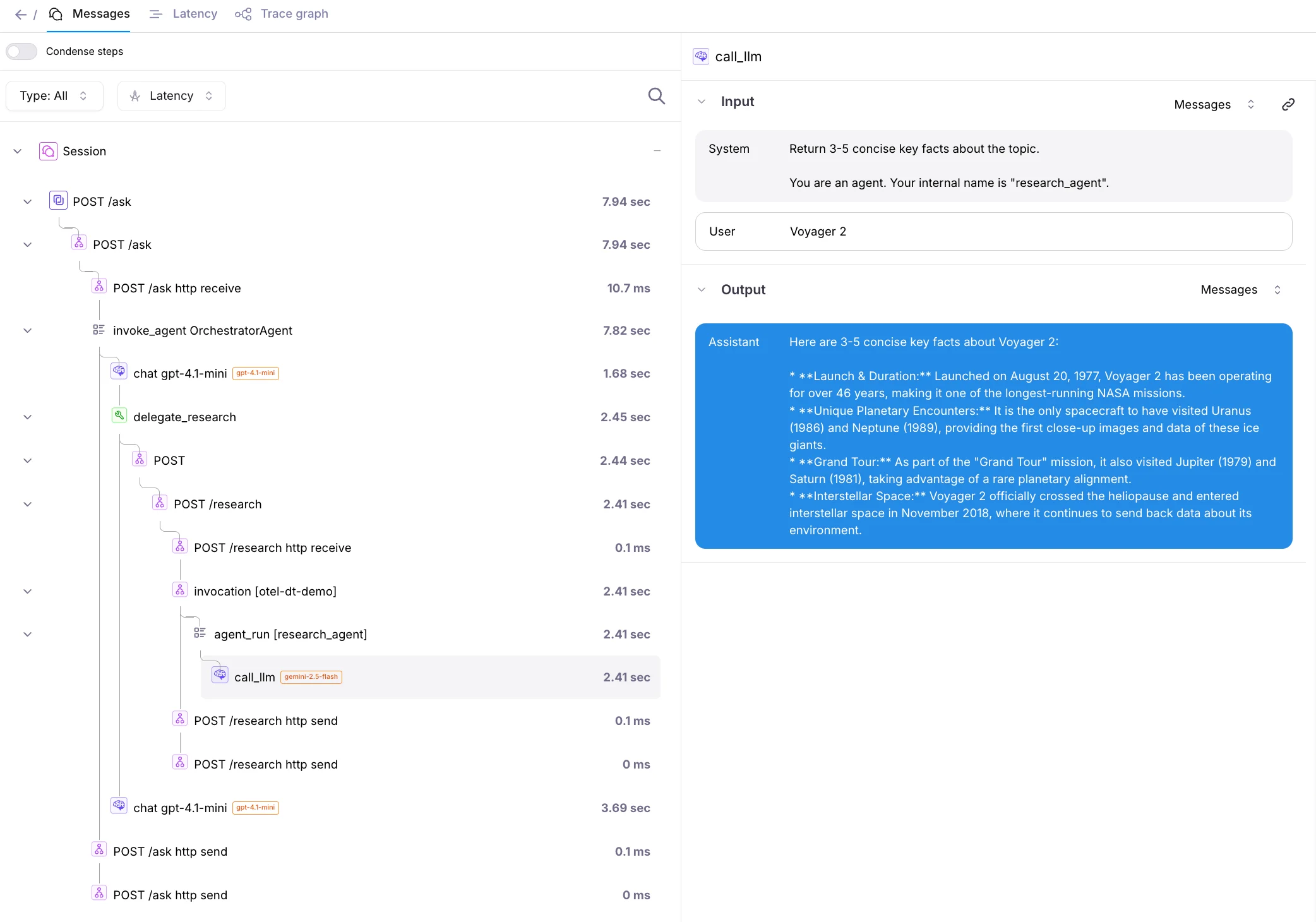
A single user request to **Agent A** that delegates to **Agent B** produces one trace:
```text theme={null}
POST /ask ← Agent A: FastAPI server span (workflow)
invoke_agent OrchestratorAgent ← Agent A: MAF agent span
HTTP POST /research ← Agent A: requests client span (workflow)
POST /research ← Agent B: FastAPI server span (workflow)
invoke_agent research_agent ← Agent B: ADK agent span
gemini.generate_content ← Agent B: LLM span
```
## Setup
```ini .env theme={null}
OPENAI_API_KEY=sk-... # find your key at https://platform.openai.com/api-keys
GOOGLE_API_KEY=... # find your key at https://aistudio.google.com
GALILEO_API_KEY=...
GALILEO_PROJECT=otel-distributed-tracing
GALILEO_LOG_STREAM=default
AGENT_B_URL=http://localhost:8001
```
```text requirements.txt theme={null}
fastapi
uvicorn[standard]
requests
python-dotenv
galileo[otel]
opentelemetry-instrumentation-fastapi
opentelemetry-instrumentation-requests
agent-framework
agent-framework-openai
google-adk
openinference-instrumentation-google-adk
```
`GalileoSpanProcessor` reads `GALILEO_API_KEY`, `GALILEO_PROJECT`, and `GALILEO_LOG_STREAM` from the environment and exports OTLP directly to Galileo's OTel endpoint. No collector required.
## Agent A: Microsoft Agent Framework, calls Agent B
```python agent_a.py theme={null}
import os
import requests
from dotenv import load_dotenv
from fastapi import FastAPI
from pydantic import BaseModel
from galileo.otel import GalileoSpanProcessor, add_galileo_span_processor
from opentelemetry import trace
from opentelemetry.sdk.trace import TracerProvider
from opentelemetry.instrumentation.fastapi import FastAPIInstrumentor
from opentelemetry.instrumentation.requests import RequestsInstrumentor
from agent_framework import openai, tool
from agent_framework.observability import enable_instrumentation
load_dotenv()
# Set the global tracer provider before any instrumentor runs.
tracer_provider = TracerProvider()
add_galileo_span_processor(tracer_provider, GalileoSpanProcessor())
trace.set_tracer_provider(tracer_provider)
# injects traceparent on outbound HTTP
RequestsInstrumentor().instrument()
# MAF built-in OTel
enable_instrumentation(enable_sensitive_data=True)
AGENT_B_URL = os.environ["AGENT_B_URL"]
@tool(approval_mode="never_require")
def delegate_research(topic: str) -> str:
"""Ask the research agent for facts about a topic."""
r = requests.post(f"{AGENT_B_URL}/research", json={"topic": topic}, timeout=60)
r.raise_for_status()
return r.json()["findings"]
orchestrator = openai.OpenAIChatClient(model="gpt-4.1-mini").as_agent(
name="OrchestratorAgent",
instructions="Use delegate_research to gather facts, then answer the user clearly.",
tools=[delegate_research],
)
app = FastAPI()
FastAPIInstrumentor.instrument_app(app)
class AskRequest(BaseModel):
question: str
@app.post("/ask")
async def ask(req: AskRequest):
return {"answer": str(await orchestrator.run(req.question))}
```
## Agent B: Google ADK research agent
```python agent_b.py theme={null}
from dotenv import load_dotenv
from fastapi import FastAPI
from pydantic import BaseModel
from galileo.otel import GalileoSpanProcessor, add_galileo_span_processor
from opentelemetry import trace
from opentelemetry.sdk.trace import TracerProvider
from opentelemetry.instrumentation.fastapi import FastAPIInstrumentor
from openinference.instrumentation.google_adk import GoogleADKInstrumentor
from google.adk.agents.llm_agent import Agent
from google.adk.runners import InMemoryRunner
from google.genai.types import Content, Part
load_dotenv()
tracer_provider = TracerProvider()
add_galileo_span_processor(tracer_provider, GalileoSpanProcessor())
trace.set_tracer_provider(tracer_provider)
GoogleADKInstrumentor().instrument(tracer_provider=tracer_provider)
agent = Agent(
model="gemini-2.5-flash",
name="research_agent",
instruction="Return 3-5 concise key facts about the topic.",
)
runner = InMemoryRunner(agent=agent, app_name="otel-dt-demo")
app = FastAPI()
FastAPIInstrumentor.instrument_app(app)
class ResearchRequest(BaseModel):
topic: str
@app.post("/research")
async def research(req: ResearchRequest):
session = await runner.session_service.create_session(
app_name="otel-dt-demo", user_id="user"
)
findings = ""
# Drain the full async generator. Returning early closes it from a
# different asyncio context and breaks OTel context-token cleanup.
async for event in runner.run_async(
user_id="user",
session_id=session.id,
new_message=Content(role="user", parts=[Part(text=req.topic)]),
):
if event.is_final_response() and event.content and event.content.parts:
findings = event.content.parts[0].text
return {"findings": findings}
```
## Run it
```bash theme={null}
pip install -r requirements.txt
# Terminal 1
uvicorn agent_b:app --port 8001
# Terminal 2
uvicorn agent_a:app --port 8000
# Terminal 3
curl -s -X POST http://localhost:8000/ask \
-H "Content-Type: application/json" \
-d '{"question": "Tell me about Voyager 1."}' | jq
```
Open the `otel-distributed-tracing` project in Galileo, Log stream `default`. You'll see one trace covering both agents:
 ## Self-hosted Galileo
The OTel endpoint is different from Galileo's regular API endpoint and is specifically designed to receive telemetry data in the OTLP format.
If you are using:
* **Galileo Cloud** at [app.galileo.ai](https://app.galileo.ai), then you don't need to provide a custom OTel endpoint.
The default endpoint `https://api.galileo.ai/otel/traces` will be used automatically.
* A **self-hosted Galileo deployment**, replace the `https://api.galileo.ai/otel/traces` endpoint with your deployment URL. The format of this URL is based on your console URL, replacing `console` with `api` and appending `/otel/traces`.
For example:
* if your console URL is `https://console.galileo.example.com`, the OTel endpoint would be `https://api.galileo.example.com/otel/traces`
* if your console URL is `https://console-galileo.apps.mycompany.com`, the OTel endpoint would be `https://api-galileo.apps.mycompany.com/otel/traces`
Set `GALILEO_API_ENDPOINT` in `.env`; `GalileoSpanProcessor` picks it up automatically.
## Related
* [Distributed Tracing (Beta)](/sdk-api/logging/distributed-tracing): Galileo's native Python SDK distributed mode.
* [Microsoft Agent Framework integration](/sdk-api/third-party-integrations/opentelemetry-and-openinference/microsoft-agent-framework)
* [Google ADK (OpenTelemetry) integration](/sdk-api/third-party-integrations/opentelemetry-and-openinference/google-adk)
* [Java + Python OTel distributed tracing example](https://github.com/rungalileo/sdk-examples/tree/main/python/logging-samples/distributed-tracing-otel-python-java): End-to-end runnable example with a Java Spring Boot gateway and a Python FastAPI + LangGraph RAG service.
## Self-hosted Galileo
The OTel endpoint is different from Galileo's regular API endpoint and is specifically designed to receive telemetry data in the OTLP format.
If you are using:
* **Galileo Cloud** at [app.galileo.ai](https://app.galileo.ai), then you don't need to provide a custom OTel endpoint.
The default endpoint `https://api.galileo.ai/otel/traces` will be used automatically.
* A **self-hosted Galileo deployment**, replace the `https://api.galileo.ai/otel/traces` endpoint with your deployment URL. The format of this URL is based on your console URL, replacing `console` with `api` and appending `/otel/traces`.
For example:
* if your console URL is `https://console.galileo.example.com`, the OTel endpoint would be `https://api.galileo.example.com/otel/traces`
* if your console URL is `https://console-galileo.apps.mycompany.com`, the OTel endpoint would be `https://api-galileo.apps.mycompany.com/otel/traces`
Set `GALILEO_API_ENDPOINT` in `.env`; `GalileoSpanProcessor` picks it up automatically.
## Related
* [Distributed Tracing (Beta)](/sdk-api/logging/distributed-tracing): Galileo's native Python SDK distributed mode.
* [Microsoft Agent Framework integration](/sdk-api/third-party-integrations/opentelemetry-and-openinference/microsoft-agent-framework)
* [Google ADK (OpenTelemetry) integration](/sdk-api/third-party-integrations/opentelemetry-and-openinference/google-adk)
* [Java + Python OTel distributed tracing example](https://github.com/rungalileo/sdk-examples/tree/main/python/logging-samples/distributed-tracing-otel-python-java): End-to-end runnable example with a Java Spring Boot gateway and a Python FastAPI + LangGraph RAG service.