

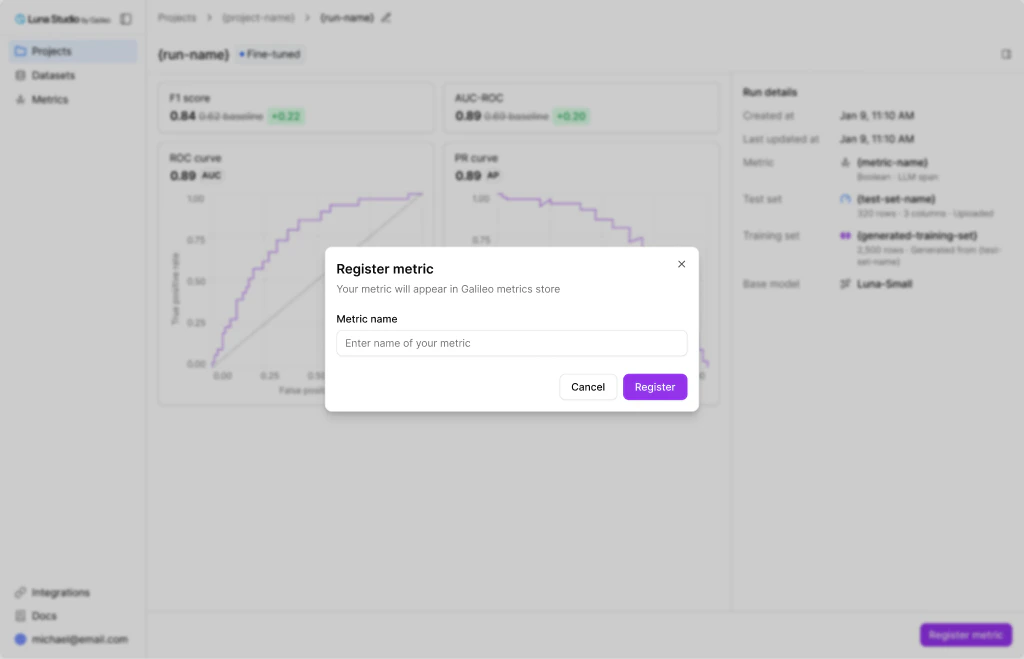
Once a run reaches Fine-tuned, you can register the resulting metric. Registration publishes the metric to the Galileo metrics store, where it becomes available across the Galileo platform — for evaluation in experiments, Log streams, and runtime guardrails using Protect / Agent Control.Documentation Index
Fetch the complete documentation index at: https://docs.galileo.ai/llms.txt
Use this file to discover all available pages before exploring further.
Prerequisites
- The run must be in the Fine-tuned status. See Run lifecycle.
- Your org must have an active Galileo integration.
Where you can register from
The Register metric action appears in three places:- Run details page — primary footer button on Fine-tuned runs.
- Training runs table — an action link on each Fine-tuned row. See Training runs home.
- Metrics page — an action link on each Fine-tuned metric. See Metrics overview.
Steps
Enter a metric name
Use a name that’s clear in the Galileo metrics store, where it’ll sit alongside built-in metrics. Examples:
support-tone-strict, pii-detector-en.Naming guidance
- Use lowercase with hyphens:
customer-tone-classifier, notCustomer Tone Classifier. - Include the language or domain if relevant:
pii-detector-en,legal-toxicity. - Add version suffixes (
-v1,-v2) if you are registering multiple variants.
Where to go next
Runtime Protection
Use registered metrics in runtime protection workflows.
Invoke runtime protection
Learn how to call Protect from code with the Galileo SDK.
Luna-2
Understand how Luna-based metrics power evaluation and protection.